‘Mental pain is less dramatic than physical pain, but it is more common and also harder to bear
– C.S Lewis
Why India is the most depressed country in the world? According to the World Health Organisation, India is most depressed country followed by China and the USA. China, India and the US are the most affected countries by anxiety, schizophrenia and bipolar disorder, according to WHO.
India
We have discussed in the previous post how insurgency deeply affected the people of Kashmir and Seven Sisters of northeast.
A study reported in WHO, conducted for the NCMH (National Care Of Medical Health), states that at least 6.5 per cent of the Indian population suffers from some form of the serious mental disorder, with no discernible rural-urban differences.
Unemployment and poverty are the major reasons in the development of depression in India. After attaining higher education youths are unable to have a satisfactory job.
Lack of proper consciousness pertaining to mental health is another cause. I have told about insurgency and the activities of extremists in some provinces of our country. Unfortunately it is a consistent cause which our government has been facing for a uncertain periods.
I think there are several factors ranging from irregular income to domestic abuse causes depression to develop in individuals. Their ability to access counselling or medicine makes it even worse for them, often culminating in suicides
Though there are effective measures and treatments, there is an extreme shortage of mental health workers like psychologists, psychiatrists, and doctors. As reported latest in 2014, it was as low as ”one in 100,000 people”. The average suicide rate in India is 10.9 for every lakh people and the majority of people who commit suicide are below 44 years of age.
A study surveyed over 10,000 Indians to understand how they have been coping with the new normal.
According to the study, 26 per cent respondents were suffering from mild depression, 11 per cent were feeling moderately depressed, and six per cent were facing severe symptoms of depression.
“The last five months have been unexpected. The situation has taken a major toll on the mental health.
With the series of lockdowns, anxiety, job cuts, health scares, and the overall volatile environment, stress levels are at an all-time high.
“Copious amounts of stress can lead to depression. With the current lockdown and lifestyles drastically changing, we have seen that 43 per cent of Indians are currently plagued with depression and are learning to cope with it,” the study said.
To monitor the severity of depression in the respondents, the study relied on self-administered Patient Health Questionnaire or PHQ-9 (a form of primary care evaluation of mental disorders).
It took into account nine aspects of an individual’s daily routine, including interest levels in activities, appetite, sleep cycles, ability to concentrate, and energy levels.
“Our study indicates that an increasing number of people across the country are dealing with mental health issues triggered by the spread of the corona virus.
“The mounting uncertainty is the basis of the high stress index which can be controlled with a balanced diet, changes in lifestyle and appropriate sleep patterns,” said Vishal Gondal, Founder and CEO, GOQii.
Those feeling depressed complained of having little interest or pleasure in doing things, feeling hopeless, dealing with erratic sleep cycles, poor eating habits, low levels of energy, low self esteem, having trouble concentrating, being restless, and having thoughts of self harm.
“More than 59 per cent of the population said they had little pleasure in doing things these days, out of which 38 per cent have this feeling on a few days and 9 per cent feel so more than half of the days. Nearly 12 per cent felt this way almost every day in these times,” the study said.
It pointed out that more than 57 per cent of the respondents complained of feeling tired or having little energy through “at least some days in the last few weeks”.
“At least more than 15 per cent have this feeling more than half of the days. This leads to some people sleeping too much while some others have trouble sleeping.
“With the change in lifestyle, approximately half of the population is having trouble with their sleep,” the study said.
“At least 7 per cent of the population goes through this nearly every day while 33 per cent experience it on a few days,” it added.
Feeling hopeless, on the other hand, was not so common among the respondents. Only 10 per cent of them said they felt “down and depressed” more than half of the days or nearly every day.
The study suggested that adding exercising to one’s daily routine could help improve their mental health.
“Exercising can lead to endorphins (the happy hormone) which can help with depression. The more depressed you are, the more likely you are to not workout.
“But, it is important to cajole yourself into doing more things that make you feel happier,” it said.
Depression in Seniors:
In India, 30 per cent of the 103 million people above the age of 60 display symptoms of depression, according to a recent government survey. It estimated that 8.3 per cent of the country’s elderly population have probable major depression. This means, one in every 12 elderly person in the country have had depression.
The prevalence figure is 10 times higher than the self-reported diagnosed depression of 0.8 per cent in the elderly population, pointing at the burden of undiagnosed cases, the report said.
Among the people who are of 45 to 59 years of age, 26 per cent show depressive symptoms.
The first chapter of the Longitudinal Ageing Study in India (LASI) was conducted by the Union Ministry of Health and Family Welfare between April 2017 and December 2018 on 72,250 older adults aged 45 years and above. The report was published on Wednesday.
More elderly women (9 per cent) have prevalence of probable major depression than men (7 per cent). Also, the figure is higher among rural residents (9 per cent) than their urban counterparts (6 per cent). The report also says that 10 per cent of the elderly population who live alone suffer from depression.
The study shows 3 per cent of all the elderly have some form of mental impairment.
Fewer people above the age of 60 who have 10 or more years of schooling (5 per cent) have depression than those with less than primary education (9 per cent).
Over a tenth of the elderly population have probable major depression in Madhya Pradesh (17 per cent), Uttar Pradesh (14 per cent), Delhi (11 per cent), Bihar (10 per cent), and Goa (10 per cent).
Among the older adults above the age of 45 years, over 60% were hospitalised at a private facility in the 12 months prior to the survey. The mean out-of-pocket expenditure in private health facility among the elderly is Rs 31,933 compared to Rs 71,232 among those aged 45 to 59.
The highest mean out-of-pocket (OOP) expenditure is reported in the state of Arunachal Pradesh (Rs 10,368) followed by
Himachal Pradesh (Rs 3,477), Nagaland (Rs 3,288) and Meghalaya (Rs 3,152). Tamil Nadu (Rs 641), Gujarat (Rs 644), and Puducherry (Rs 645) reported lower mean OOP expenditure on outpatient care.
Around 6 per cent of the country’s elderly population live on their own while 5.2 per cent have said they have faced ill treatment at home in the one year preceding the survey.
How to Overcome Depression?
With the WHO stepping up to encourage people to come forward and talk about depression and making the disease one of the main talking point of World Health Day, 2017. The condition is gradually making itself heard in mainstream conversation.
The government and other NGOs, also mental health workers are now trying to reach out to more people and asking them to come forward with their condition. It’s only then possible to further research about causes and solutions on depression properly.
Government should provide low cost access to mental healthcare and medicine so that the common people can be treated depression and get free it leading a joyful life.
How to battle depression
Finding meaning in life through love and work and being socially connected are important
We became felt immense agony when we listened to a bright star in Bollywood ended his life owing to depression. When a young person who had many years of productive life left, who was a National Olympiad Winner in Physics, and who left a career in mechanical engineering to become a talented and popular actor, takes such an extreme step.
It’s a collective loss to the nation. He was also a budding entrepreneur. It is sad that a prodigious actor and an exceptional citizen is no longer with us.
Also read :
Life is sometimes filled with anxiety, internal conflict, disharmony, uncertainty and fear of the unknown. These thoughts give way to myriad feelings.
One tends to feel like a stranger to one’s self. COVID-19 has acted as a catalyst inducing angst in the life of individuals who are already stressed because of various factors and modern lifestyles.
Stress in modern life
There are many factors that cause stress in modern life. They include more engagement with technology and less with people; more focus on “success” (the ends) rather than the process of learning (the means); never-ending aspirations; relationship issues; impatience while doing tasks.
This is a generation looking for instant gratification; and too many choices and the limitations of the human mind to choose wisely.
With the bridging of gender inequalities, increase in employment of women, growth and development of urban and peri-urban areas, interference of the media and social media in every aspect of life, and disruption in the traditional joint family system, there is an underlying strain on the socio-cultural fabric. Some of this stress, if not handled well, can push human beings into depression.
Some interesting cases and studies throw light on the coping mechanisms for anxiety and depression. Viktor Frankl, who was detained in Nazi concentration camps, studied the source of depression and found that it is the lack of meaning in life.
Individuals who are able to discover meaning tend to achieve the will and strength to endure life.
That brings us to the next question: how do we find meaning in life? Meaning can be found in love and work. Love for fellow beings is what motivates a person to work or take action. If we can base our actions and work on a shared love for family members and society at large, we can find effective meaning in life. ‘The Art of Living’ involves managing the self for others.
We have already discussed about our great poet, Rabindranath Tagore who had to face depression and was going to suicide.
Prescriptions for depression and anxiety can be found in the writings of Rabindranath Tagore. Tagore believed that being socially connected was an antidote to the mental estrangement that plague-affected people were undergoing in 1918.
Tagore was aware that such a wildly contagious disease was likely to cause panic among the students. He organised many events in the Ashram which ensured that social connections existed despite physical distance.
In an essay, he suggested that we generate bonhomie between the affected and those who were not, because the ill were not the enemy; the illness was.
For immunity from psychological suffering, what was required was a design of togetherness, which Tagore insisted was ingrained in the famous Rig Vedic dicta, Yatra Visvam Bhavati Ekanidam (where the whole world meets in a single nest) and Vasudhaiva Kutumbakam (the world is one family).
Connecting with friends and family members:
Besides finding meaning in life, social connect is very important. I feel that positive and continuous communication is the key to end the misery of anxiety, depression and stress to achieve higher levels of well-being.
This is an earnest request to all the students and teachers who are under any form of stress, or tend to feel depressed, to reach out and talk to people, whether friends or relatives.
Generally a depressed person may not want to connect initially. Therefore, I appeal to family, relatives and friends to watch out for signs in their near and dear ones of persistent sadness, aloofness, loss of interest in activities and appetite, negative thoughts including about self-harm, and provide immediate support and connect.
We must not stigmatise the condition of mental health issues; it can happen to anyone. Instead, let us support our family and friends to tide over the difficult times with love and care. In doing so, we will overcome from this silent disease.
We have discussed depression in the characters of Ramayana and Mahabharata in my previous posts. Mental trauma perhaps didn’t occur to common folks. Before modern era, Indian common citizen was accustomed in simple living and high thinking.
Depression is the outcome of modern lifestyle and culture. Modern people are running towards physical amusement and worldly longings. They want to fetch limitless prosperity. Naturally when it’s not possible to earn, they are going through a mental trauma.
Especially Educated youths are in great trauma due to the unavailability of jobs. The security of women, economically and socially, are diminishing. Society is changing, so the new generation. They are choosing their life partner. So if it’s up to the mark, then fine. If not, it will be troublesome. Therefore, they have to face mental trauma.
Mental, physical and social health, are vital strands of life that are closely interwoven and deeply interdependent. Mental disorders affect people of all countries and societies, individuals at all ages, women and men, the rich and the poor, from urban and rural environments.
Depression is more likely following particular classes of experience – those involving conflict, disruption, losses and experiences of humiliation or entrapment. Many people living amidst the rages of conflict suffer from post-traumatic stress disorder.
Today, we shall try to find out the depression in the people of Kashmir where the people had to face a long term insurgency.
Depression in the Population of Kashmir:
To determine the characteristics of depression in the population in Kashmir where a low-intensity-conflict has been going on for the last two decades.
The non-combatant civilian population was surveyed. The Centre for Epidemiological Studies Depression (CES-D) Scale was used to measure symptoms of depression in community populations.
Due to continuing conflict in Kashmir during the last 18 years there has been a phenomenal increase in psychiatric morbidity. The results reveal that the prevalence of depression is 55.72%. The prevalence is highest (66.67%) in the 15 to 25 years age group, followed by 65.33% in the 26 to 35 years age group.
Females have an overall prevalence of 60 per cent while as males have 51.34 per cent. Significant difference in the prevalence of depression among males and females is in the age group of 36 to 45 years and 46 to 55 years who have p values of 0.005 and 0.013 respectively.
Females have a higher prevalence of depression in all the age groups than males and it is highest in the age group 26 to 35 years (68.66%). Females in the age group of 15–25 years also have similar prevalence rate of depression (68.64%). In males prevalence of depression is highest in the age group of 15–25 years (64.61%) followed by 62.65% in the age group of 26 to 35 years (62.65%).
The difference in the prevalence of depression among males and females is significant. Depression is much higher in rural areas (84.73%) as compared to urban areas (15.26%). In rural areas the prevalence of depression among females is higher (93.10 %) as compared to males (6.8%).
How To Control It?
Mental health is an integral part of overall health and quality of life. Effective evidence-based programs and policies are available to promote mental health, enhance resilience, reduce risk factors, increase protective factors, and prevent mental and behavioural disorders.
Innovative community-based health programmes which are culturally and gender appropriate and reaches out to all segments of the population need to be developed. Substantial and sustainable improvements can be achieved only when a comprehensive strategy for mental health which incorporates both prevention and care elements is adopted.
0 World Health Organization has ranked depression as the fourth among the list of the most urgent health problems worldwide and has predicted it to become number two in terms of disease burden by 2020 overriding diabetes, cancer, arthritis etc.
The magnitude, suffering and burden in terms of disability and costs for individuals, families and societies are staggering . Mental disorders are universal, affecting people of all countries and societies, individuals at all ages, women and men, the rich and the poor, from urban and rural environments.
Mental functioning is fundamentally interconnected with physical and social functioning and health outcomes. The mental health is influenced by displacement through conflict and war, by stresses on families, and by economic adversity.
For the many persons who face uncertain futures (including those by conflict or disasters), the burden of serious emotional and behavioural disorders afflicts their lives. Many people living amidst the rages of conflict suffer from post-traumatic stress disorder.
At the dawn of a new millennium, communities and societies increasingly face situations of armed conflict. While this trend is apparent in different parts of the world, it is of particular concern to the South Asian region.
Violence is a phenomenon intrinsic to class-based societies which are inherently unequal and oppressive. Violence here may either take implicit forms in the manner of institutionalized oppression and inequality, or a more explicit form of state oppression through the use of state sanctioned institutions, such as the police, the military and courts.
It could even assume a more direct form, whereby civilians manage the task of a weakened state through militia groupings. Large-scale violence may also take the form of mass uprisings against the oppression of dominant classes. Civilians are increasingly being targeted in these episodes of contemporary violence.
To reduce military casualties, civilians are used as protective shields; torture, rape and executions are carried out to undermine morale and to eradicate the cultural links and self-esteem of the population.
Most civilians witness war-related traumatic events such as shooting, killing, rape and loss of family members. The extent of psychosocial problems that results from this mass exposure to traumatic events can ultimately threaten the prospects for long-term stability in society.
Despite growing evidence over the past two decades of the terror – both of the physical and mental dimensions of war upon civilians – much of post-conflict activity tends to concentrate on physical reconstruction – roads, bridges and buildings.
Moreover, even though psychological and psychic injuries can have more damaging, long-term consequences as other injuries from a situation of conflict, they remain undetected and distanced from any plans for rehabilitation. Partly this is because these injuries are difficult to fathom in terms of the enormity of scale and the delayed manifestation of symptoms which can sometimes take years to surface. Physical violence may be easier to identify, name and quantify than psychic or symbolic violence.
Kashmir has been regarded by many as heaven on earth. Its splendid beauty and hospitable population is legendary. Over the past 18 years Kashmir became associated with violence.
The objective of this study was to determine the characteristics of depression in the non-combatant civilian population of Kashmir where a low-intensity conflict has been going on for more than 18 years. Study was conducted during 2005–06.
Security concerns are amongst the dominant themes in the minds of people living in Kashmir. This owes to the fact that death, injury, destruction of property is the notable features of life here due to conflict, disturbances and turmoil for the last 18 years.
Many have suffered tragic incidents of a war-like situation, which by their nature are beyond the endurance of common man. Many are witness to bloodshed that is characteristic of such situation. Thousands of people have lost their lives or limbs, and thousands have been rendered orphans and widows. Scores have disappeared. A colossal damage to property is evident.
Many educational and healthcare institutions have suffered damages. Those who have survived all this, continue to be reminded of their vulnerability through the media of killings that make the headlines almost daily.
Moreover, with disruption of development works consequent upon warlike situation, added concerns are unemployment, poverty, relationships etc.
A vicious circle of events has been created comprising torture, disappearances, displacement, killings, ballistic trauma, etc. paralleled by a state of mind wherein grieving, insecurity, oppression, poverty, uncertainties of career and relationships etc. are the major themes.
• Modern Society and Mental Stress. • How to Overcome Depression?
• The Various Causes Of Mental Illness
Do you know that the modern world passing through a hectic schedule and almost all people are facing mental trouble due to that? As a result, stress and depression a silent pandemic is growing in the world.
Today’s modern society having a lot of painful diseases the most and dreadful one is mental stress and depressions.
We have lost so many dear and near one as recently spreading out the pandemic “ Covid 19”. Our colleagues, friends, relatives, known and unknown people are not happy because of demise of their parents, or their adjacent neighbourhood.
Not only Covid, modern times give us so many mental troubles though it has also provided us a comfortable life. In spite of that we are not happy and contented .
Stress – free life is not the consequences of modern life. More or less, we have to face mental stress and anxiety in our daily lives.
What is Stress?
Stress is the feeling of being overwhelmed or unable to cope with mental or emotional pressure. Stress effects everyone. All of us experience stress from time to time.
Why difference from other Diseases?
Mental health disorder is somewhat different from other diseases. There must be a cause behind any physical disease. It may be affected by any germ or viruses, but the cause behind mental disorders are not germs or viruses.
Cause Behind the Mental Illness:
Mental stress and tension creates underneath the mind a kind of panic, restlessness, fears of death, loss of property or money, insecurity in life and so on.
It generally borne out from the imbalance of body and mind. We can say that mental illness like stress, anxiety, depression – all these disease grow up from Psychosomatic disease.
What’s actually Psychosomatic?
The word “ Psyche “ means Mind and “ Soma “ means Body. The main role acts behind this disease is our competitive upbringing and fast growing modern lifestyle.
The more we are running to achieve success in love and life, the more we are forwarding towards a personal longing where there is a hope, the more we have to encounter with the uncertainty of lives, the more we are to face mental fatigue. The massive mental fatigue syndrome turns out to mental illness.
We sometimes relinquish it, but it gradually increases problems. Perhaps we may not able to get a sound sleeps. Busy scheduled, hectic workload might be the cause of mental disorders. We can’t keep pace with the massive routine of daily tasks. So the result is stress and anxiety.
Some Stories: Depression A Silent Pandemic:
Since ancient times people expressed their feelings of depression. Today, what we call as a disease of passion, – in which there is mental depression in one side, and other side is reckless amusement and worldly pleasure. We can find such restless minds, reckless amusement and pleasure and ultimately victims of depression in our mythology and history.
In Old Testament, there is a memorable story of depressing king. His name is king Sal. The great epic of Homer’s “ Illiad “, the Epic- poet describes a picture of suicide of Ajacks, which took place due to mental depression.
Four hundred years before the birth of Jesus Christ, Hippocrates described about depression of mind. There he used a word “ Melancholia” in this description. Still we are using this word as a definition of depression.
Roman Doctor, Aulas Kornelious Selsus in his book “ Di Re Medicine” explained the cause of depression. He guessed black bile juice as the cause of depression. The origin of the Greek word “Melancholia” comes from it. ‘ Melan’ means black and ‘ Chol ‘means bile ( Pitto ).
In the history of ancient Indian medicine “ Ayurveda “, the wise doctors said that the sound health of body and mind depends on the balance of four physical juices.
We noticed so many descriptions of mental depression in our old manuscripts and epics like the Ramayana and the Mahabharata. A lot of facts about suicide due to depression had been depicted there.
King Dasharath And Depression :
Like common people, King Dasharatha had to face depression three times in his gorgeous and stupendous life. King was attacked by depressions. First depression came to his mind when he incidentally killed a son of a blind parents.
Second time Dasharatha felt depressed when his most adorable and dearest hermit Rishi Viswamitra left from him along with his offsprings.
Third and finally, he became depressed when his two sons Rama and Laxmana left their kingdom along with Sita as they were exiled for fourteen years.
Ultimately, he became felt unwell due their absence. Melancholy was his companion unto the last breath. In Ramayana, it’s described that Dasharatha had been suffering from long time mental pain, sorrows, and the disruption of peace.
Even his father, King Aja died fifteen years after his wife, Indumoti’s untimely death. During fifteen years he had been suffering from depression. It’s due to melancholy. Grief and isolation wrapped him up for a long time. He did not have any foods and naturally had died unfed.
Depression The Silent Pandemic & Godly Man Rama :
Rama, the godly man was also attacked by depression when he was only 15 years old. In Ramayana, the poet describes the depressive state of mind :
Once the physique of Prince Rama was vibrant, now it turns into sicky, feeble and unfolding. He looks like a cloudy and depressed just like a draughted river. He has lost his glamour of physical body due to depressions. His bloody calm and quite face and his bright eyes turn into Teddy like a white padma.
Rama used to sit on padmasona ( yoga posture) keeping his one hand under the face. He is very thoughtful and sorrowful. He has not concerned about his daily activities. He is in deep sorrows and despair.
No one couldn’t understand why Rama is in this state of mind. His followers and nearer one asks him why he is in this state of mind? But Rama won’t reply to this question. Only being despair and depressed he ate something and very unconsciously do some work.
The modern medical science describes some characteristics or symptoms of depression like rickety, loss of appetite, unwilling to perform any work, forgetful mind, anxiety, lethargy, mood swings, over passionate or zero interested, not interested in moving anywhere, cloudy mind, absent of mind, sicky complexion etc. We see some similar characteristics in the appearance and attitudes of godly man, Rama.
This kind of sorrowfulness, melancholic attitude of one’s mind sometimes acts like a infective disease. We become involved in it and feel sorrow and pain.
Naturally when we see in film the melancholy appearance of the actor who is acting as Rama, we are saddened being involved. According to Aristatle, it’s called as “ Cathersesis”.
But the poet didn’t refer any incident for the cause of depression faced by Rama. There was no incident behind Rama’s depression. The Priest of the kingdom says that there is no worldly discontent of Rama. Anything, worldly consumption he had not willing to have. Or this state of Rama’s mind is neither for loss of anything, not for any accident, or sudden death of nearest one. This grief, suffering and sadness is from inner world.
We can’t get any sources of information about this melancholy. It’s different from the any other mental depression .
Ram Chandra again absorbed by the depression at the age of 18. The Raj – Vaidya Bashistha gave him some spiritual advice and Rama felt well.
It’s truth that when we are to face any trouble and become restless and depressed, reading Gita every day is a fantabulous remedy for a steady flow of positive energy. It calms our mind.
In this connection here I remember the wish of Rama. He expressed his willingness to take suicide several times.
When Ram Chandra came to know that his dearest brother made suicide sinking in deep river Saroyu, he became speechless and massively depressed. Ultimately he got suicide in the same river jumping in the deep water.
It proves the fatality of this silent disease. The story is not finished. The end of episodes is very saddestic. Everyone of Auyoddha became stunned by sorrows and melancholy hearing the demise of Rama and Laxmana.
Following two elders, Bharat and Shatrughna committed suicide afterwards in the same river. It’s an incident of mass suicidal cases in our history.
Ishwar Chandra Bandyopadhyay, the Renaissance- man is still remembered for his contributions in the society and in educational arena of Bengal. Today, he was born in Birsingha village in Hooghly district of Bengal on September 26, 1820. He is famous as “Vidyasagar”as he was an eminent intellectual and scholar of contemporary India.
Eshwar chandra Vidyasagar belonged to a Hindu Brahmin family, and was born to Thakurdas Bandyopadhyay and Bhagavati Devi. He was not privileged enough to have a gas lamp at his home and the desire to acquire knowledge made him study under the streetlights.
Through scholarships, he made a quick succession and joined Sanskrit College in Calcutta and graduated in the year 1841.
It took him 12 years to graduate from college as he was also pursuing his part-time job while studying at the same time. He had a qualification in Sanskrit Grammar, literature, dialectics, Vedanta, smriti, and astronomy.
He was also a social reformer, philosopher, philanthropist, and educationalist with a modern vision. He was a person with high morality, honest character, truthfulness, social reform, unselfishness, and liberalism.
Contributions of Ishwar Chandra Vidyasagar:
He contributed to the removal of social justice, upliftment of women, allowing widow remarriage, and advocating against polygamy.
He played a major part in being appointed as the Head Pandit of Fort William College on December 29, 1841. During that time he felt the need to publish books. Because there’s available no books for learning Bengali and other subjects.
Ultimately, he started writing books for this purpose. For learning Bengali language, he wrote ” Barnaporichay ” which is ever remembered. We have read this book in our childhood. This was only book in our childhood to be read for learning Bengali alphabet, punctuation, meaning and so on.
The Pioneer Of English Education:
Ishwar Chandra Vidyasagar, the Renaissance- man opened schools for girls and brought significant reforms in the education sector by bringing justice and equality for women through education.
He brought social reforms to change the orthodox Hindu society from within.
He was also a great intellectual activist of the 19th century who installed socio-religious reforms into modern history.
Ishwar Chandra Vidyasagar established a number of model schools in Hooghly, Midnapore, Burdwan, and Nadia.
He introduced monthly exams instead of annual ones, supervised schools, and changed the syllabus.
He brought the study of English, Western Science, and Mathematics into the syllabus.
Ishwar Chandra Vidyasagar also started the acceptance of tuition fees and admission fees and made Sunday a weekly holiday.
The revolution in the education system in Bengal was also made by him.
Ishwar Chandra Vidyasagar’s social reforms included ‘Bidhobabivah’ on the widow’s right to remarry (1855), ‘Bahubivah’ on the banning of polygamy (1871), and Balyabivah on the flaws of child marriage.
For imparting education to kids of surrounding areas of Durgapur steel city, Swami Vivekananda Vani Prochar society opened more than 40 schools. About 3000 ( three thousand) kids are being taught there.
Most of the NGOs engage the kids in programmes and later admit them into government schools or small private schools, if their parents can afford the fees. But Swami Vivekananda Vani Prochar Samity of Durgapur Steel City, are always trying to educate the kids through their own schools.
Food and Nutrition for the Kids:
Most of the tribal kids are having lack of nutrients. They are not fed properly. That’s why, society regularly providing them a tiffin which includes a glass of milk, pan cakes, boil eggs.
These kids are from a most vulnerable tribal societies. They are first-generation getting education. Their parents are very poor. Most of them are daily labour. They used to collect shal leaves and supply it to Mahajan. Mahajan gives them very little money to pay for their labour.
Lady volunteers work with these schools and follow up on the kids.
They provide incentivising services to these primary schools like taking over their sports programmes, running their parent-teacher meetings, conducting teacher training programmes, and helping them set up laboratories and libraries.
This provides the children an incentive to become regular.
The other part of sustenance is working with their families, because if the environment in these children’s homes are not healthy, they will drop out.
The kids aren’t motivated to get to school if there is substance abuse, domestic violence or financial problems at home.
The society tries to have a proper understanding of their homes and help create solutions.
Their support programmes include bringing in healthcare, running vaccination camps (for babies and now for COVID), skill training for mothers, de-addiction for father, etc.
Mostly, they are trying to provide shelter, education, sports, and other facilities.
Challenges NGO Face :
The main problem for slum kids is poverty related.
It could be caused due to unemployment and lack of education among their parents, poor sanitation, no running water, substance abuse, lack of proper housing, etc.
For the society, the challenge is limited resources. At times something as simple as finding the right teachers seems like a huge challenge.
Not everyone wants to come and teach in a slum because of the unhealthy conditions there.
To go into that environment and stay there the whole day can be pretty challenging for a qualified person who could get a job elsewhere.
That’s why for the teacher more than employment, it has to be a calling — some kind of passion.
Another challenge is to work with the system.
For example, running water is not available in many slums.
Tankers provide water which is expensive and supplied at specific times.
Several children can’t go to school because they have to get water when the tanker comes.
Then there are times when kids are pulled out of school to look after a younger infant.
These are real-life issues that people face, and to get children to school we need to come up with solutions.
The government’s role in helping educate more children
If the government is system-centric, things won’t work. They have to be people-centric.
When we try to enroll street kids in schools, we are asked about their birth certificates, which these kids don’t have.
It will really help if the government can become more child-centric.
In many places the anganwadi structure is there, but how many of these are functioning?
Also, it is important for the teachers to be passionate. Our society are always beside the teachers. They are given a monthly remuneration. Though it’s very small.
In India, teachers are one of the least paid employees despite teaching being one of the most challenging jobs.
I feel people who are working in challenging environments should be paid more, otherwise there is no motivation for them.
The children attending aganwadis may have problems at home, so there is little motivation for them to attend school.
Their parents would rather have them work and bring home money.
Despite their challenging situations back home, there must be something so attractive for the child to wake up in the morning and say, ‘I can’t wait to go to the anganwadi.’
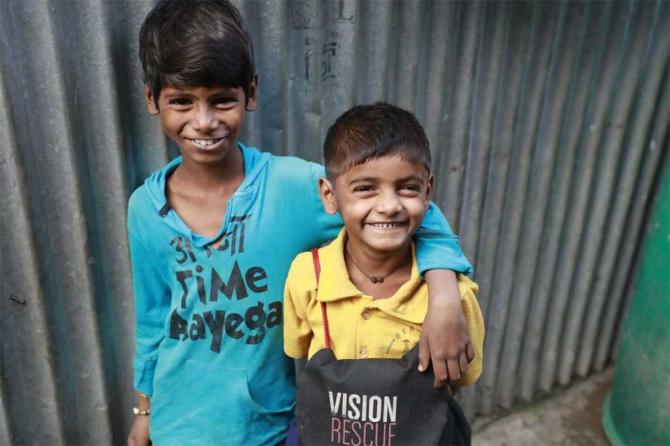
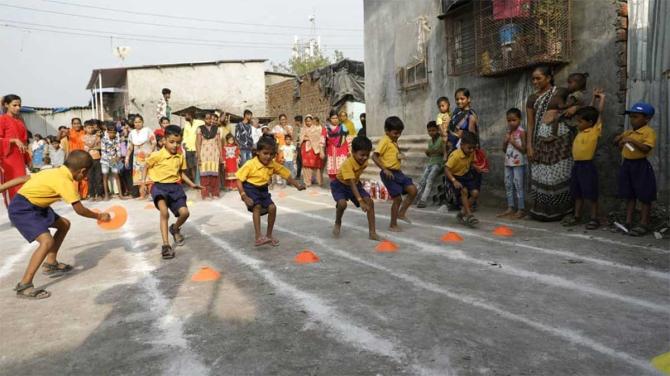
IMAGE: To sustain children in education, some NGOs also provides them with nutrition, healthcare services and sports education.
Some of the children we have trained are working with us.
It feels so good to see the children, who have come through our educational programme in the early years, finally graduating.
One of my favourite stories is about this child who was with us at a baking centre in a red light area.
When we first got introduced to him, he wanted to become a goonda. Later he wanted to become a policeman.
A few years ago he graduated from high school. At that time when asked what he wanted to do, he said, ‘I want to get educated and work in child protection.’
Stories like that are what make me go back every morning and do it all over again.
A message for people who’d like to help
In school, most of the teachers have said the pledge, ‘All Indians are my brothers and sisters. I love my country…’
If we really mean what we said, that’s enough. One doesn’t need to wait for the government to come forward to help.
If somebody from your family was in need, would you wait for someone to come and help?
Why blame the system when we can start doing things in a small way?
Vivekananda Vani Prochar Society is such a community whose main objective is to do something for the downtrodden society. Sacrifice and service to man is their main motto.
Who is the pioneer of Bengali novel? This is a long – debated question and we can not say clearly that anyone of the earlier writers is to be the pioneer of Bengali novel. Surprisingly some critics opinion that the first Bengali Novel was not any Bengali but a Swiss woman Hana Catherine Mullens (1826–1861), her father came to Chinsurah as a preacher of Christianity.
Miss Mullens was taught both Bengali and Sanskrit from the early days of her teens. She wrote Phulmani O Karunar Bibaran (Description of Phulmani and Karuna), in 1852. ( Wikipedia)
But other critics say that Bhabani Charan Bandhopadhay, the editor of Sambad Kaumudi and Samachar Chandrika had published first novel Kalikata Kamalalay (1823), Nabababubilas or the Amusements of the Modern Baboo (1825),Dyutibilash (1825),Nababibibilash (1831),Sri Sri Gayatirtha Bistar,Ashcharya Upakhyan (1835),Purushottam Chandrika (1844). But his works hardly satisfy all the characteristics of Novel. (Wikipedia)
So Bhabani Charan with his Naba Babu Bilash (1825) may claim the first place.
Again Peary Chand Mitra, from Young Bengal Society may also be counted as the first writer of Bengali Novel for his Alaler Gharer Dulal (Bengali: আলালের ঘরের দুলাল, published in 1857) is a Bengali novel by Peary Chand Mitra (1814-1883). The writer used the pseudonym Tekchand Thakur for this novel. (Wikipedia) This novel by its merit may claim the first printed novel in Bengali.
As per Sansad Bangali Charitabhidhan page 423, Harinath Mazumdar or Kangal Harinath wrote a novel Bijay Basanta at the same time.
Most of us would probably say ‘Alaler Gharer Dulal’ (1857-58), written by Peary Chand Mitra under the pseudonym Tekchand Thakur is the first novel. Again, we would be wrong.
While a pioneering novel in many ways, this wasn’t the first published novel in Bengali. That honour goes to a book that all but a handful of scholars have forgotten, written, of all people, by a Swiss woman.
The novel in question is ‘Phulmani o Karunar Biboron’, published in Bengali in 1852 and rapidly translated into several Indian languages thereafter. Forgotten for about a century, the novel was rediscovered in the 1950s by Chittaranjan Bandyopadhyay, then employed at the National Library.
Going through old Bengali books for a particular project, he stumbled upon the 300-page book, its pages crumbling, but professionally printed. He didn’t find any author’s name anywhere, but going through the book, realised it must have been written by a woman.
Finally, he consulted an old catalogue to find out that the author’s name was Hana Catherine Mullens. Realising the value of the book, Bandyopadhyay had the book republished in 1959.
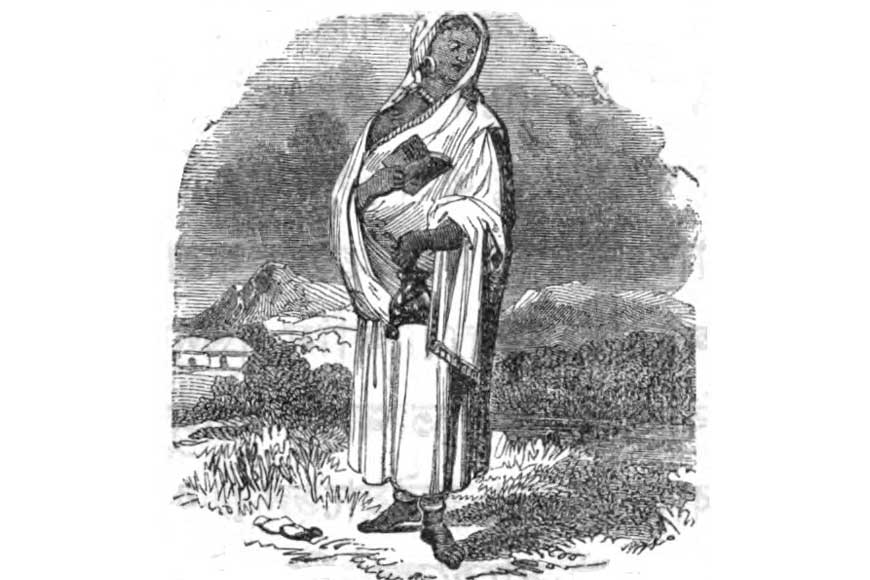
The pioneer of Bengali Novel/ image:www.kalpatarurudra.org/jpg
Born Hana Catherine Lacroix in Calcutta, she was the daughter of Alphonse François Lacroix, a Swiss Protestant missionary who went to Chinsurah in 1821, and Hannah Herklots, who was from a Dutch colonial family.
Thanks to her interactions with household staff since a young age, she developed an astonishing command over spoken Bengali at a very early age. So much so that when she was only 12, she began teaching Bengali in a newly established school. The family travelled back to Europe when she was 15, and Hana trained to be a teacher in London before returning to Calcutta.
In 1845 she married Joseph Mullens, a fellow missionary, who had travelled out to India on the same ship as Hana’s father. The couple continued their work in Calcutta for several more years. Because of her fluency in Bengali, Hana became head of a boarding school for girls, and taught Bible classes to women.
Apart from Phulmani o Karunar Biboron, which bore the tagline that it had been written ‘for the benefit of women’, Hana’s lasting legacy will remain the zenana missions (zenana were the secluded living quarters of girls and women, similar to purdah), where Hana began an outreach programme to educate women.
Having persuaded the widow of a Hindu doctor to accommodate zenana teaching in her home, she negotiated other similar arrangements. By the time of her death in 1861, she was overseeing four zenana missions and visiting another eleven missions every day.
Thus, over two decades before Swarnakumari Devi became the first Bengali woman to write a novel (Deepnirban in 1876), Hana Catherine Mullens had broken new ground and gone where no one had gone before. Happily, her book is once again available for readers, and irrespective of literary merit, deserves to be read for its historic value alone.
Bankim Chandra Chatterji?
the Bengali novel actually started its journey with Durgeshnandini written by Bankim Chandra Chattopadhyay in 1865. According to Ananda Sanker and Lila Ray, ‘when the novel was introduced in Bengali in the middle of the 19th century, the form itself was new, the prose in which it was written was new, the secular tone was new in a country hitherto wholly dominated by religion, and the society in which and for which it was written was new’ (p. 168). But some great novelists like Bankim Chandra Chatterjee, Rabindranath Tagore, Manik Bandopadhyay, Tarashankar Bandopadhyay, and Sarat Chandra Chattopadhyay developed the newly introduced genre in such a way that ‘new’ changed into ‘matured’ through their works. Almost all these literature were published from Calcutta.
We sometimes lose our immunity and feel sick. We become weak and don’t like to perform our regular works with plenty of pleasure. There can be many reasons for susceptibility to sickness and disease — physical imbalance, stress, improper diet and lifestyle to name a few. Here’s need to be practised some yoga and asana with regular basis.
Though some of these may require medical attention and diagnosis. But one can also address these conditions naturally through yoga practice.
To build good immunity we need to be in a state of natural wellness, and our body should be able to easily defend itself from any kind of disease or infection.
However, rigorous training causes strain to the body, which can diminish immunity.
So how do you find the balance between training and maintaining good health?
A few yoga asanas helps strengthen immunity and reverse cellular damage caused by aging. In order to maintain health and vibrancy in your routine, you should practice yoga for a few minutes every day.
Here are 7 asanas that can help boost your immunity system and ward off illness:
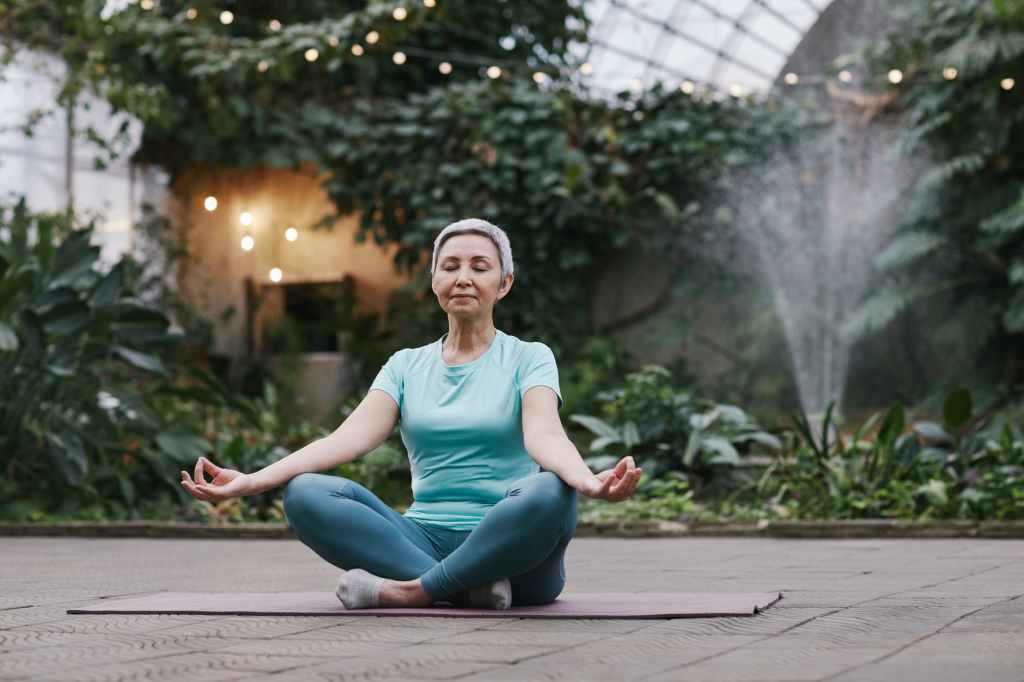
Yoga Mudra is a very ancient yoga posture which had beendoneby Rishi Muni. Mukta Yoga Mudra( Sukha asana ) is something easierform of Yoga Mudra. Anybody can perform this posture.
It’s also called as Sukhasana.
Sit down on the flooreither in Padmasana ( Lotus pose) or in Sukha asana ( easy pose ) as shown in the above picture. Hold the spine, neck and head absolutely erect. Look forward, straight at the level of your eyes. You may shut your eyes also. Stretch your arms and rest your wrists on the knees.
Then exhale slowly through both nostrils and simultaneously pull your stomach inward, i.e. contract the abdominal muscles to expel air from your lungs. Keep exhaling till all the air is expelled.
Having exhaled, hold yourself in that position for a second and then start slowly inhaling through both nostrils. Inhale as deeply as you can by stretching out the abdominal muscles.
After inhaling deeply, pause for a second and then start exhaling again. Continue this process 10 to 15 minutes.
Benefits: It helps you to enrich your immunity. It activates all the organs of the digestive system. Because of this internal activation, disorders of the digestive system are removed and corrected. Problems like constipation, dysentery, diarrhoea, gastric indigestion and stomach ache are corrected.
However, it is a kind of pranayama that effects various glands of the endocrine system. The adrenal, pancreas, ovary in female and testicles in males are specially activated and energised. Because of their internal activation, these glands begin to secrete their respective hormones in a normal way.
It also corrects disorders of the circulatory and respiratory systems.
2. Naga asana ( Cobra asana )
Nagasana and Bhujangasana – both are same. Nag means snake. Bhujanga means also snake in Sanskrit. This asana looks like a snake. So it’s called as Nag Asana/ Bhujangasana. The above posture is one kind of Nag Asana. It’s very easy to perform. There is another posture which I have given below( 5 no).
There I have discussed in details about it.
3. Vir Bhadrasana
It is an extremely powerful and important yoga posture as it strengthens the whole body, improves stamina, and increases the amount of energy you can expend in your daily life.
It also improves metabolism due to the increased energy utiliWation.
It regulates blood pressure and helps the neural, digestive and circulatory systems. It also aids in the functioning of the auditory organs.
Not only does this strengthen the quadriceps muscles but also provides a great stretch to the shins. The posture is one of five yoga asanas that stretch the inner thigh.
4. Dhanurasana (Bow Pose)
To begin this asana, lie flat on the floor on the stomach with legs stretched out and hands beside the body.
Gradually, inhale slowly and raise your knees and clasp your ankles.
Slowly inhale while lifting your chest. Now, pull your legs and stretch them out to form the shape of a bow.
It is a great antidote against unnecessary stress and strengthens the spine.
This pose also works to improve natural immunity.
5. Bhujangasana (Cobra Pose)
This pose trains the body to be flexible, toned and strong.
It involves placing your hands on the floor while extending your legs backward and balancing the spine over a tight core.
This position helps open up your upper back and chest muscles, improves digestion, tones pelvic muscles and stretches hamstrings.
It also builds the strength of your arms and shoulder muscles.
Doing this regularly provides an excellent massage to the internal organs in the abdominal region.
6. Tadasana (Mountain Pose)
This posture is the foundation for all the standing poses.
All you need to do is stand on both legs with both hands reaching up to the sky. Repeat on each side up to 10 times.
After some time, you can slowly lift your head as if you are looking at the horizon, with your palms together and elbows lifted.
This pose improves posture, stimulates organs, improves your immune system and strengthens your legs and arms.
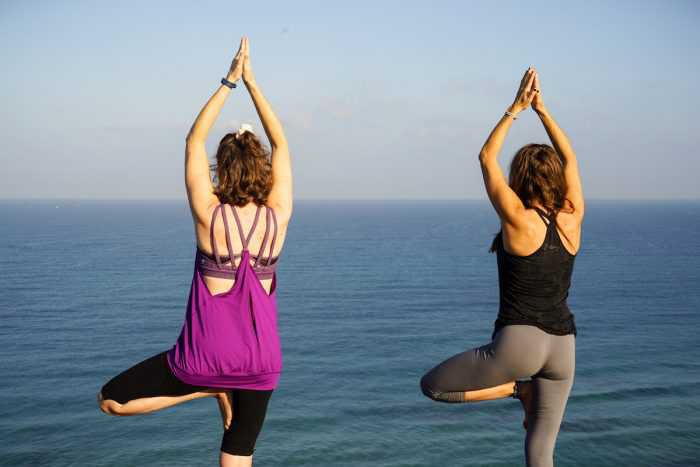
7. Vriksasana (Tree Pose)
The tree pose is one of the most important and commonly practiced asanas in hatha yoga.
Ten minutes of this posture will strengthen immunity and help prevent diseases; 10 hours of work behind a desk is likely to do the opposite.
This asana provides numerous physical and mental benefits including improved functioning of internal organs, blood, and nerve supply.
It helps in stress management along with treating various other diseases like obesity, rheumatism, backache and depression among others/
Practicing it regularly will help to improve the health of your immune system, especially your defense against colds and upper respiratory infections.
All these asanas activate the immune system but it is not a conventional type of immunity enhancement.
It increases the ‘natural killer cell’, an aspect of the body’s immunity that is very different from the development of resistance to infection by parasites and viruses.








 Rudra's Blog
You must be logged in to post a comment.