

Who is the pioneer of Bengali novel? This is a long – debated question and we can not say clearly that anyone of the earlier writers is to be the pioneer of Bengali novel. Surprisingly some critics opinion that the first Bengali Novel was not any Bengali but a Swiss woman Hana Catherine Mullens (1826–1861), her father came to Chinsurah as a preacher of Christianity.
Miss Mullens was taught both Bengali and Sanskrit from the early days of her teens. She wrote Phulmani O Karunar Bibaran (Description of Phulmani and Karuna), in 1852. ( Wikipedia)
But other critics say that Bhabani Charan Bandhopadhay, the editor of Sambad Kaumudi and Samachar Chandrika had published first novel Kalikata Kamalalay (1823), Nabababubilas or the Amusements of the Modern Baboo (1825),Dyutibilash (1825),Nababibibilash (1831),Sri Sri Gayatirtha Bistar,Ashcharya Upakhyan (1835),Purushottam Chandrika (1844). But his works hardly satisfy all the characteristics of Novel. (Wikipedia)
So Bhabani Charan with his Naba Babu Bilash (1825) may claim the first place.
Again Peary Chand Mitra, from Young Bengal Society may also be counted as the first writer of Bengali Novel for his Alaler Gharer Dulal (Bengali: আলালের ঘরের দুলাল, published in 1857) is a Bengali novel by Peary Chand Mitra (1814-1883). The writer used the pseudonym Tekchand Thakur for this novel. (Wikipedia) This novel by its merit may claim the first printed novel in Bengali.
As per Sansad Bangali Charitabhidhan page 423, Harinath Mazumdar or Kangal Harinath wrote a novel Bijay Basanta at the same time.
Most of us would probably say ‘Alaler Gharer Dulal’ (1857-58), written by Peary Chand Mitra under the pseudonym Tekchand Thakur is the first novel. Again, we would be wrong.
While a pioneering novel in many ways, this wasn’t the first published novel in Bengali. That honour goes to a book that all but a handful of scholars have forgotten, written, of all people, by a Swiss woman.
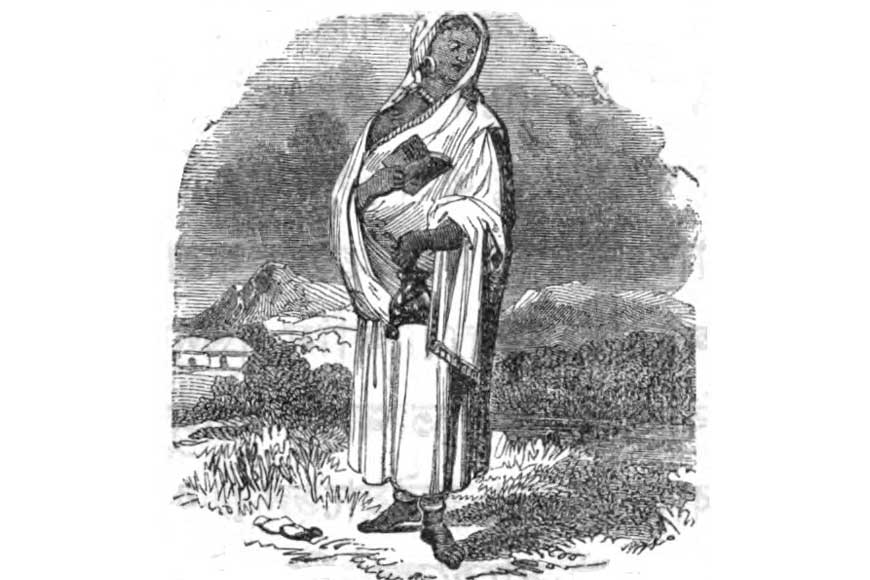
The novel in question is ‘Phulmani o Karunar Biboron’, published in Bengali in 1852 and rapidly translated into several Indian languages thereafter. Forgotten for about a century, the novel was rediscovered in the 1950s by Chittaranjan Bandyopadhyay, then employed at the National Library.
Going through old Bengali books for a particular project, he stumbled upon the 300-page book, its pages crumbling, but professionally printed. He didn’t find any author’s name anywhere, but going through the book, realised it must have been written by a woman.
Finally, he consulted an old catalogue to find out that the author’s name was Hana Catherine Mullens. Realising the value of the book, Bandyopadhyay had the book republished in 1959.

Born Hana Catherine Lacroix in Calcutta, she was the daughter of Alphonse François Lacroix, a Swiss Protestant missionary who went to Chinsurah in 1821, and Hannah Herklots, who was from a Dutch colonial family.
Thanks to her interactions with household staff since a young age, she developed an astonishing command over spoken Bengali at a very early age. So much so that when she was only 12, she began teaching Bengali in a newly established school. The family travelled back to Europe when she was 15, and Hana trained to be a teacher in London before returning to Calcutta.
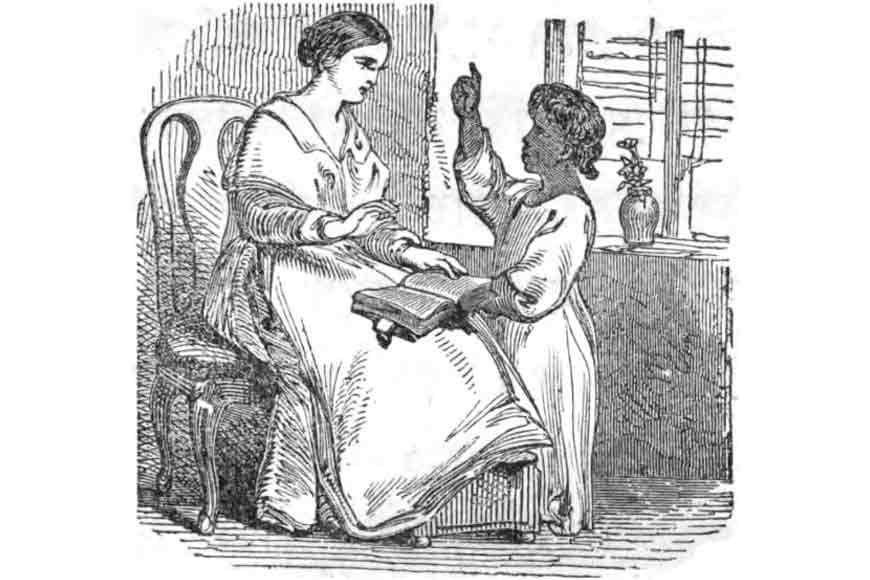
In 1845 she married Joseph Mullens, a fellow missionary, who had travelled out to India on the same ship as Hana’s father. The couple continued their work in Calcutta for several more years. Because of her fluency in Bengali, Hana became head of a boarding school for girls, and taught Bible classes to women.
Apart from Phulmani o Karunar Biboron, which bore the tagline that it had been written ‘for the benefit of women’, Hana’s lasting legacy will remain the zenana missions (zenana were the secluded living quarters of girls and women, similar to purdah), where Hana began an outreach programme to educate women.
Having persuaded the widow of a Hindu doctor to accommodate zenana teaching in her home, she negotiated other similar arrangements. By the time of her death in 1861, she was overseeing four zenana missions and visiting another eleven missions every day.
Thus, over two decades before Swarnakumari Devi became the first Bengali woman to write a novel (Deepnirban in 1876), Hana Catherine Mullens had broken new ground and gone where no one had gone before. Happily, her book is once again available for readers, and irrespective of literary merit, deserves to be read for its historic value alone.
Bankim Chandra Chatterji?
the Bengali novel actually started its journey with Durgeshnandini written by Bankim Chandra Chattopadhyay in 1865. According to Ananda Sanker and Lila Ray, ‘when the novel was introduced in Bengali in the middle of the 19th century, the form itself was new, the prose in which it was written was new, the secular tone was new in a country hitherto wholly dominated by religion, and the society in which and for which it was written was new’ (p. 168). But some great novelists like Bankim Chandra Chatterjee, Rabindranath Tagore, Manik Bandopadhyay, Tarashankar Bandopadhyay, and Sarat Chandra Chattopadhyay developed the newly introduced genre in such a way that ‘new’ changed into ‘matured’ through their works. Almost all these literature were published from Calcutta.
 Rudra's Blog
You must be logged in to post a comment.